
How Much Topsoil Do I Need to Cover a Yard?
If you’re planning a lawn install, a yard renovation, or a top-dressing refresh on a North Bay property, the question that stalls most projects is the same: how much topsoil do you actually order?
Order too little and you’re paying for a second truck. Order too much and you’ve got a pile to deal with for weeks. Both cost money. The good news is the math is straightforward once you know the depth your job actually calls for.
Here are the best practices crews and homeowners across Vallejo, Napa, Benicia, and the surrounding area use to size a topsoil delivery the right way.
Key Takeaways
- Topsoil quantity comes down to two numbers: square footage and depth
- Depth depends on the job: ¼ to 1 inch for top-dressing, 3 to 4 inches for a new lawn, 4 to 6 inches or more for renovation grading
- Convert to cubic yards with: (square feet × depth in feet) ÷ 27
- Most jobs benefit from a 10% buffer to avoid a second delivery trip
- Prepping the ground first protects your math and your investment
- A quick call to Bayshore Materials confirms your numbers before the truck rolls
Match the Depth to The Project
Depth is where most people guess wrong. Here’s what works for the three jobs most North Bay properties run into:
- Top-dressing an existing lawn: ¼ to 1 inch. Enough to even out low spots, refresh nutrients, and improve drainage without smothering the existing grass.
- New lawn install (sod or seed): 3 to 4 inches minimum. Roots need room to establish, especially in compacted Bay Area soils.
- Yard renovation or regrading: 4 to 6 inches, sometimes deeper. If you’re fixing slope, drainage, or building new beds, plan on more.
If you’re combining jobs (regrading half the yard and top-dressing the rest, for example), calculate each area separately and add the totals.
Measure the Yard Accurately
A rough guess on square footage is where both over-ordering and under-ordering start.
- For a rectangular yard: length × width
- For an L-shape or odd shape: break it into rectangles, measure each, then add them up
- For curves or planting beds: estimate the equivalent rectangle and round up slightly
Measure with a tape measure, not by pacing. A 10-foot mistake on a 50-foot yard adds 500 extra square feet of soil you didn’t budget for.
Use the Cubic Yard Formula
Topsoil is sold by the cubic yard. Once you have your square footage and depth, the formula is:
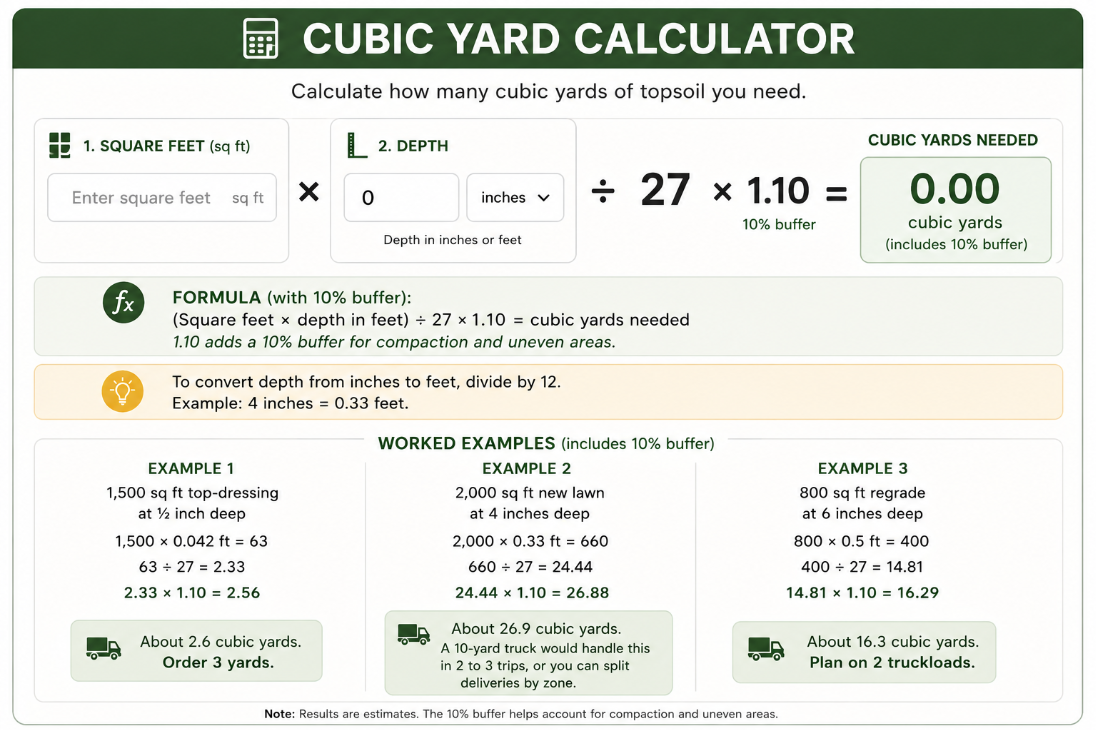
(Square feet × depth in feet) ÷ 27 = cubic yards needed
To convert depth from inches to feet, divide by 12. So 4 inches = 0.33 feet.
Worked Examples
Example 1: 1,500 sq ft top-dressing at ½ inch deep 1,500 × 0.042 = 63 ÷ 27 = about 2.3 cubic yards. Order 3 yards.
Example 2: 2,000 sq ft new lawn at 4 inches deep 2,000 × 0.33 = 660 ÷ 27 = about 24 cubic yards. A 10-yard truck would handle this in 2 to 3 trips, or you can split deliveries by zone.
Example 3: 800 sq ft regrade at 6 inches deep 800 × 0.5 = 400 ÷ 27 = about 15 cubic yards. Plan on 2 truckloads.
Add a 10% Buffer
Real yards aren’t flat. Settling, low spots, soil compaction under truck wheels, and a little spillage all eat into your delivered volume. A 10% buffer covers it.
If your math says 10 yards, order 11. The difference is small at the order stage but big if you run out mid-job and have to schedule a second topsoil delivery.
Prep the Ground Before the Soil Arrives
Even perfect math fails if the ground underneath isn’t ready. A few quick checks before delivery day:
- Clear debris. Old sod, rocks, and weeds compete with new soil.
- Loosen compacted areas. North Bay yards often have clay-heavy subsoil. Breaking up the top few inches helps topsoil bond and drain.
- Check drainage. Low spots will collect water through the rainy season if you don’t grade them out now.
- Stake out depth. Drive marker stakes at your target finish height so you can spread evenly.
A little prep here means your 4 inches actually stays 4 inches a year from now.
Schedule Your Topsoil Delivery
Bayshore Materials has been delivering topsoil, sand, base rock, and bark across Vallejo and the North Bay since 1964. Crews from Napa, Benicia, American Canyon, and Fairfield call when they need:
- Dump trucks that haul up to 10 yards per load
- Staff who’ll check your math before the order locks in
- Same-region scheduling, with peak-season planning advice in spring and early summer
- Bulk material pricing built for both job sites and large DIY projects
Getting the quantity right comes down to a measured yard, the correct depth, and a quick formula check. If you’d rather have a second set of eyes on the numbers before the truck rolls, that’s a 2-minute call.
Contact us online or call Bayshore Materials at (707) 644-0859 to confirm topsoil quantities and schedule delivery.
Frequently Asked Questions
What if I order too much topsoil?
Extra topsoil keeps if it's tarped and stored on a flat surface. It's useful for raised beds, low-spot repair, and future planting. Most homeowners would rather have a small extra pile than wait days for a second delivery.
How deep should topsoil be for new sod?
3 to 4 inches minimum. Sod roots need room to establish, and Bay Area clay subsoil doesn't drain well, so depth matters more here than in looser soils.
Can I mix topsoil with compost for planting beds?
Yes, and most landscape pros do. A roughly 70/30 topsoil-to-compost mix works well for general beds. Call Bayshore to ask about garden blend options if you'd rather buy it pre-mixed.

Owner and President, Bayshore Materials, Inc
Keith Orantes is the Owner and President of Bayshore Materials, Inc., a family-run landscaping, masonry, and concrete supply center serving the North Bay since 1964. He joined the company in 1983 and has helped expand product lines and delivery capabilities, including concrete U-Cart trailers, four-yard concrete delivery, and a broad catalog of brands and materials used by contractors and homeowners across the region. Keith oversees day-to-day operations, customer service, and supplier relationships, and is known locally for hands-on support that helps customers select the right tools and materials for the job. Bayshore Materials operates from its Vallejo headquarters and serves surrounding cities with in-store pickup and scheduled deliveries.
